
George Washington connects with our 16th president at the Lincoln Memorial
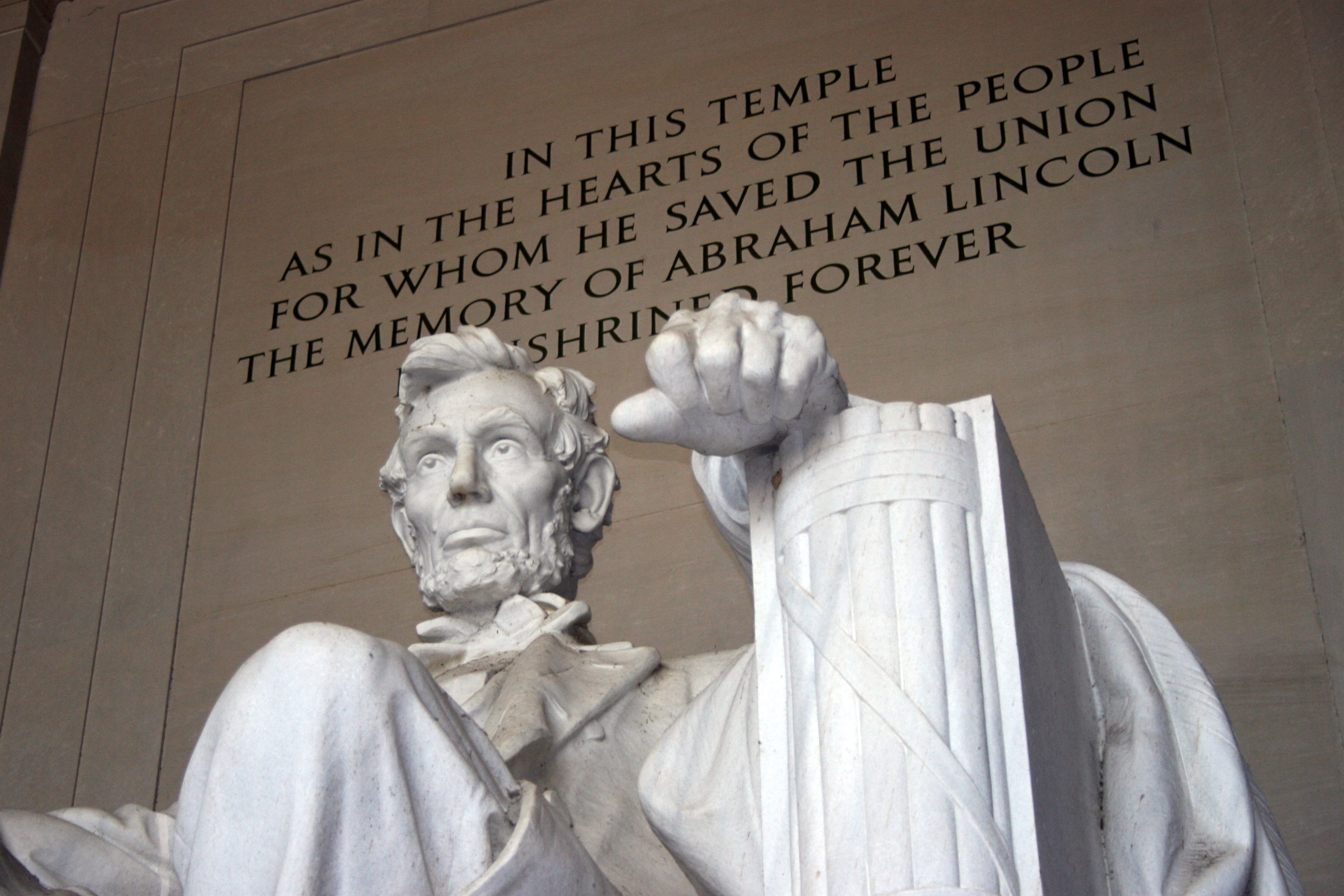
Since learning of the Civil War earlier in the day, Mr. Washington had been thinking about Lincoln. He was haunted by Lincoln’s weary and prematurely aged face. What kind of a man was he? Did Mr. Washington and his founding brothers fail? Lincoln was not a founder, but perhaps he was more of a founder than the revolutionaries themselves. Mr. Washington sensed Providence would reveal her intentions at the memorial to this great man.

“The Lincoln Memorial stands as a neoclassical monument to the sixteenth president.”
This initial description drew Mr. Washington’s attention among others. His mind then drifted momentarily to his own death and wondered if he was interned with Martha at Mt. Vernon as he had requested. His mind now back to the matter at hand, the General looked to Jenson to continue.
“The north and south side chambers contain carved inscriptions of Lincoln’s Second Inaugural Address and his Gettysburg Address.”
Jenson described these speeches as two of the finest pieces of oratory in American history. The Second Inaugural Address was given toward the end of the Civil War. The Gettysburg Address was a brief but wholly powerful message delivered during the war, November 19, 1863, on the very site of the most bloody of all battles, Gettysburg, Pennsylvania.
Jenson, too, enjoyed his moment before Mr. Washington, noting that Lincoln offered the speech to honor the dead and, as he said, “To consecrate that very battlefield in Pennsylvania to those who gave their lives that their country might live.”
Mr. Washington, thinking the background was complete, turned toward the statue and started to make his way inside. The group turned and followed as Jenson concluded his illustration.
“This has been the site of many very large public protests and gatherings over the years, including one of the most famous speeches in American history—the “I have a dream” speech delivered here by a black man, Martin Luther King Jr. in 1963, one hundred years after Lincoln.”
Tim was rolling and went on to explain how King, fighting for equal rights for blacks 100 years after the emancipation, delivered the famous words, “I have a dream that my four little children will one day live in a nation where they will not be judged by the color of their skin but by the content of their character.”
The quote made Mr. Washington stop in his tracks. He did not turn back but only listened as he looked up at the stone face of the sixteenth president.
“Mr. President, I believe we have reached a point in this country where the dreams of you, Mr. Lincoln, and Dr. King have been realized.”
The group now found themselves under the cover of the Memorial’s ceiling. They mingled with the small group of tourists that remained in the late afternoon. Mr. Washington could not take his eyes off Lincoln. He noticed the inscription above the statue that read:
AS IN THE HEARTS OF THE PEOPLE
FOR WHOM HE SAVED THE UNION
THE MEMORY OF ABRAHAM LINCOLN
IS ENSHRINED FOREVER
George looked to the left wall facing Lincoln and read the surprisingly brief Gettysburg Address. He smiled proudly as he read the first sentence of the famous address, a sentence that was directed toward him and the original founders. He choked up as he mouthed the words, “Four score and seven years ago our fathers brought forth on this continent a new nation, conceived in liberty and dedicated to the proposition that all men are created equal.”
He thought to himself that this president had summed up all the founders original ideas for a new nation in one glorious passage.
As Mr. Washington finished reading, he looked around. While the others went to and fro, the Murrays followed the father of our country. Jack noted that Mr. Washington read the powerful speech a second time. He stayed at Mr. Washington’s side as the president moved unannounced to the opposite side of the memorial to read Mr. Lincoln’s concise Second Inaugural address, delivered March 4, 1865:
Fellow Countrymen: At this second appearing to take the oath of the presidential office, there is less occasion for an extended address than there was at the first….
With malice toward none; with charity for all; with firmness in the right, as God gives us to see the right, let us strive on to finish the work we are in, to bind up the nation’s wounds; to care for him who shall have borne the battle, and for his widow, and his orphan—to do all which may achieve and cherish a just, and a lasting peace, among ourselves, and with all nations.
Mr. Washington read this speech a second time as well. He stayed on the final stanza, repeating this several times out loud to the delight of a few loiterers. He then asked that they return to the coach and go back to the inn to rest before dinner. Anders was immediately on the phone to the drivers, instructing them to pick up the team at the base of the steps. All started down, looking forward to checking in to the hotel for a respite, reflecting on these extraordinary events and hopefully enjoying a good dinner.
The sun, rising in the east over the US Capitol Building and the Washington Monument, shone its golden rays around the great obelisk and across the reflection pool as if to awaken the sixteenth president residing in his memorial.
The white limo’s back driver side door swung open and out stepped an energized and purposeful General George Washington, followed one at a time by his new founders. Each looked around and enjoyed the warm sunshine of this July 5th morning. Always mindful of the weather, Jenson thought to himself that it would be a hot one again today. But the sun felt just right….
The men stood outside of Josh’s limo at the bottom step of the Lincoln Memorial. They could not stop thinking of the sermon they had heard fifteen minutes earlier. They mulled around the sidewalk for a few moments while Mr. Washington studied each man, noting their expressions. The silence was broken by a smiling Anders.
“Gentlemen, Mr. President, I believe we all experienced an epiphany at the National Cathedral. All of us have been wondering since Friday afternoon why we were brought together in Philadelphia, the forces at work, and what they have in store for us. Well, I believe we received our answer this morning. Providence spoke to us and has led us to this brilliant morning. As President Reagan so optimistically stated, ”It’s morning in America.”
With that said, General Washington looked up the steps of the memorial and led the men past a small number of early morning tourists to the summit. The father of our country was once again face-to-face with the larger than life President Lincoln.
Mr. Washington walked to his left and studied the inscribed Gettysburg address. He then turned right and focused on Lincoln’s second inaugural. As George focused, he inched toward the middle of the rail and began speaking aloud, first directed toward the men and then for all within earshot.
“Indeed, anything is possible in this great land of ours. President Abraham Lincoln had uncommon strength, courage, and conviction. He took the sacred oath of office clear and forthright in his noble intentions, committed to relegating the shackles of slavery across these United States to, as President Reagan said in describing the demise of the Soviet Union, the scrapheap of history, while somehow bringing the nation together.”
The men shot each other looks of astonishment. Hahn mouthed to the others, “What the hell?”
Anders shrugged, smiled and winked at Jenson, Hahn, and Murray. “I guess he watched the History Channel in the hotel this morning.”
The men looked down and chuckled as George resumed his lecture. “I see a man before me who knew that his ideals were supported by the majority, vehemently rejected by many and deemed worthy of war by all. I see a man who was viewed by more than a few as a tyrant, yet brought the country together. And yet with the threat of certain war looming, Mr. Lincoln steadfastly held his guiding principles.”
Mr. Washington reviewed the growing audience that built around him. He started to walk slowly toward the top of the steps and into the morning sunshine. While his audience grew, so did his ideas and the strength in his voice. Mr. Washington said he could see the steadfastness in Lincoln’s clinched fist and steely eyes. He described Lincoln as a man who may have bent during the horrific stresses of war but who refused to break.
George then quoted a founding father. “As Thomas Paine once wrote, ‘Tis the business of little minds to shrink; but he whose heart is firm, and whose conscience approves his conduct, will pursue his principles unto death.’”
Mr. Washington was now on the top step of the Lincoln Memorial. He stood tall, erect and strong, as the crowd grew. Many cell phones were pointed in his direction, recording every word. One phone hoisted in the air to capture the moment belonged to Josh Anders. Even the park rangers moved in closer to listen. One even handed George his megaphone which he politely declined. “The founders had not settled the question of slavery when the Constitution was adopted. It was left to the next generation to decide, but, like Mr. Lincoln, they truly believed in the individual’s liberty and freedom in the Natural Rights of Man.”
He spoke extemporaneously, something not lost on the new founders. “Thomas Jefferson wrote in the Declaration of Independence, ‘That all men are created equal, that they are endowed by their creator with certain unalienable rights.’ Not all Caucasian men, but ALL MEN. Jefferson also wrote that the abomination of slavery must end, stating that there is a superior bench reserved in Heaven for those who hasten it.”
Looking toward the turgid crowd, a more confident and passionate Mr. Washington began reciting some of the most famous words in American history. “‘Four score and seven years ago…that we here highly resolve that these dead shall not have died in vain, that this nation under God shall have a new birth of freedom, and that government of the people, by the people, for the people shall not perish from the earth.’”
He paused as the waves of people soaked in one president’s words delivered by another. He needed to connect these words and show relevance in today’s world. “Yes, the founders did bring forth a new nation dedicated to the proposition that all men are created equal. That founding principle is ingrained in our Declaration of Independence and Constitution, documents which lay out our principles as American citizens, inspired not from some legislature or monarch, but from God the Almighty Himself, stressing that our government is of, by, and for the people, not of, by, and for the government, nor of one man.”
Mr. Washington chastised today’s political class by pointing out that while DC had monuments to great men and women, there are too many monuments erected by government in honor of itself. He directly cited the colossal edifices erected for the Departments of Education and Agriculture. He questioned why anybody would have veritable monstrosities dedicated to bureaucracies called the Housing and Urban Development, and the Department of the Interior.
Looking right at Jack Murray, he asked if these leviathans were chartered in the United States Constitution. Before Jack could even shake his head, a spontaneous, “No!” erupted from the fervent crowd.
The new founders looked at each other with nervous smiles. Jack’s initial impulse was to try and stop a scene from developing, but all the men quickly realized that the assemblage was directed by Providence itself. They stood and listened, as enthralled by Mr. Washington’s words as the mesmerized tourists surrounding him.
“In his second inaugural, Mr. Lincoln teaches us that ours is a just God. That the pain the country endured, indeed the pain that Lincoln himself endured, was as deep as the lashes from the whip of slavery. Lincoln was of one mind with the founders over four score years before.”
He again quoted himself by explaining that the determinations of Providence were always wise, often inscrutable, and though its decrees appeared to bear hard upon us at times, was nevertheless meant for gracious purposes.
“Lincoln reminds us that even after enduring such pain, we will look to God’s example to reconcile and come back together as a people. And that is a lesson for the ages.”
As the unknown speaker paced the top step, the crowd followed, cell phones and video cameras trained on him. Mr. Washington slowly walked down the steps toward the reflection pool, pausing on a lower step to conclude his speech for the day.
“Political party allegiances have replaced the allegiance to the American people. President Washington predicted their danger over two hundred years ago, when he said that they serve always to distract the public councils and enfeeble the public administration. He said they agitate the community with ill-founded jealousies and false alarms. He believed they kindled the animosity of one party against another and opened the door to foreign influence and corruption.”
George urged the crowd to look to Mr. Washington’s and Lincoln’s examples and reject party allegiances and put the good of the country above the wants of the party. He stressed that by doing so, the American people would once again be free to pursue the unalienable right of their happiness. He warned that failure to do so would hasten our collapse.
The General paused for a moment, as if to gauge the reaction of the captivated multitude. He wanted to finish on a high note, and he would not be denied. “Remember, these United States of America are exceptional in the history of human civilization. Do not let anyone or any law makers tell you what you or your family can or cannot have. Do not let them tell you what you or your family can or cannot achieve. Your life belongs to you. Your happiness is yours to define.”
Hahn leaned toward Jenson and Murray and whispered that he felt like he was dreaming. The two men hardly acknowledged their colleague as they remained riveted on their new leader. “Be sure that your public servants understand that they work for you. They are there to clear the way for your pursuit of happiness and not to limit it!”
By now, the crowd had surrounded Mr. Washington and the new founders. A number of well-wishers started to reach out and touch the first president, as if to ensure that he was not a mirage or a figment of their imagination. The General had whipped the mass into a near frenzy and his cabinet of gentlemen sensed it was time to depart.
To Jack’s relief, Josh Anders took the initiative and quickly called his driver while motioning the men to surround Mr. Washington like secret service agents and lead him to the approaching limo.
The crowd followed with thunderous applause as their chant of “MORE” echoed throughout the mall and within the Lincoln Memorial itself. As the group of men hurried to the waiting car, Mr. Washington stopped and paused yet again. He placed one foot on the floorboard of the back seat, stood tall above the crowd, and surveyed the scene. “Thank you for sharing this moment in history with me. God bless all of you and God bless the United States of America!”
The crowd, having drawn silent when Mr. Washington raised himself up, erupted into a deafening cheer, followed by a rousing “USA” chant. The father of our country gave one last look around, smiled, and disappeared into the idling limousine. At once, the people rushed the car to get a look at the most powerful and mesmerizing speaker they had ever laid eyes on. But their looks were fleeting as the car sped away toward the Jefferson Memorial….
The New Founders is available at Amazon, Kindle and Barnes & Noble.